
India's travel agent and tour operator offering Goa travel information, tourism in Goa and Goa tours and travel packages.
Goa Travel Guide
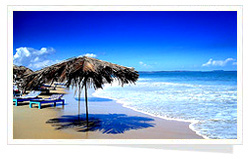 |
For a first visit to India, travel in Goa is highly recommended as it offers diversity and the elements that are too many, the very essence of India - superb sights, reins of Portuguese culture, sun, sand and beaches and above all a great, carefree and warm travel experience. Goa is a land known for its atmosphere, its wonderfully fresh seafood cuisine, its sense of joie de vivre, its people, its churches and temples, and last but not the least for its beaches.
|
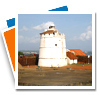
Fort Aguada & Copndolim One of the main bastions commanding the entrance into the Mandovi River was Fort Aguada. |

Mapusa A small town clustered around the Mount (Alto) is Mapusa. It forms the hub of north Goa with an even blend | 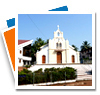 Margao The main population center of southern Goa is Margao, the capital of Salcete Province. The town still has reminders of the Portuguese past. |
 Old Goa 9 km from the East of Panjim is Old Goa and is popular for its churches and cathedrals. |

Panjim The state capital of Goa is Panjim and is popularly known as the seat of the Government. It also houses the head |
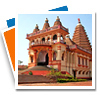
Ponda Ponda is also known as Antruz Mahal. It's called so because of the concentration of culture, music, drama and poetry. |
 Vasco-De-Gama Goa's most cosmopolitan city, Vasco-Da-Gama, also known as Vasco, it lies on the narrow western tip of the Mormugao peninsula, overlooking the mouth of the Zuari River. Acquired by the Portuguese in 1543, this strategically important site was formerly among the busiest ports on India's west coast, and it remains a key-shipping center, with container vessels and iron-ore barges clogging the choppy river mouth. Vasco-Da-Gama is almost 30 km from Panaji and is also the railway terminus for passenger service. The Mormugao Harbor, one of India's few natural harbors is 4 km from Vasco at one end. | ||
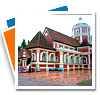 Churches of Goa The churches in Goa largely reflect European architectural styles. Majority of the churches in Goa were built during the Portuguese regime. |
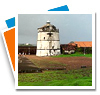 Forts in Goa With a history that speaks of several rulers, it is little wonder that one finds forts in Goa. Certain witnesses of the past, in form of forts, still remain. |
 Lakes & Waterfalls in Goa There are quite a few picturesque lakes, springs and waterfalls gifted by Mother Nature, in the interior regions of Goa, away from the coast. |
 Watersports in Goa Goa offers an extremely good climate and excellent facilities for water sports in India. Going by the interests of visitors |
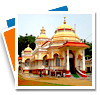
 Temples in Goa The temples of Goa date back to over a thousand years. Visiting these temples makes one realise that they have not been touched bycommercialization. |
 Ayurveda in Goa The ancient way to tone up your mind, body and soul |
 Wildlife in Goa The wildlife sanctuaries Goa are a haven for animals. Flora and fauna is well preserved in the sanctuaries of Goa. |
 Goa Sightseeing Goa has a number of churches, ancient temples wooden carvings, running brooks and lakes nestling on hillsides, mysterious forts more. |
 History & Culture of Goa Goa was a part of the Mauryan Empire, around third century BC. The Satvahanas of Kolhapur, & the Chalukyas of Badami |
| Capital: | Panjim or Panaji |
| Main Attractions: | Beaches, Churches & Seafood |
| Best Time to Visit: | October to February |
| Languages Spoken: | Marathi, Konkani, & English |
Beauty can be quite inebriating and in Goa you have so much of it - in the golden sands, the blue waters, the sylvan forests and the lakes. Visiting Goa usually covers the normal tourist circuits including one or two beaches, shopping / hopping at Mapusa, and Madgoan or Panajim. But there is more. In Goa, you have to put in more days to fully savor the place, the pleasure of discovering a crab under a stone, churches of Old Goa, temples in small villages, and the peace of watching a quiet sunset on a beach. The whole experience is miraculous in distressing oneself. Such is the beauty and magic of Goa, which has more than 100 km of coastline and the sea has different shades to offer at various places. One can rest assured that the mood of the sea will not be repeated in Goa.
When To Visit:
The best time to visit Goa is from October to March
Getting There:
By Air : Goa's entry point for travelers coming by air is its international airport is Dabolim, which is 29 km from Panaji, on the coast near Vasco Da Gama. Most domestic airlines operate in Goa apart from chartered private airlines operating from UK and Germany. Indian Airlines has direct flights from Delhi and Mumbai daily.
By Rail : Goa is very well connected by rail from Mumbai (490 km), Bangalore (430 km) and Delhi (1,874 km). The two main stations of Goa are at Margao and Vasco Da Gama.
By Road: Goa is easily approachable from Mumbai and Banglore by road. There are lots of private deluxe coaches available besides Maharashtra, Karnataka and Goa transport corporation buses. Car rental service is also available to reach Goa by road. Goa's main bus station is Kadamba.
By Sea
For the travelers who like to enjoy sea route, there is a boat service available from Mumbai to Panji which takes about 8 hrs.
Local Traveling in Goa:
There are plenty of coaches, car rental services, taxis available for visitors to travel locally in Goa. One major attraction is availability of motor bikes that can be taken on rent for traveling in Goa. Ferry services are also available at various beaches.
Geography of Goa:
Goa is a state, situated on the western coast of the Indian Peninsula andseparated from Maharashtra by the Terekhol River in the north, Karnataka in the south, the Western Ghats in the east, and the Arabian Sea in the West. The state is located between the latitudes 15°48'00" North to 14°53'54" North and longitudes 74° 20'13" East to 73° 40'33" East.
The major rivers and streams flowing through the state are Tiracol, Mandovi, Zuari, Sal, Talpona, Galgibagh, and Chapora. Some of the famous lakes in the state are Mayem and Carambolim. Most of the rivers are navigable and are of immense economic importance as ores are transported through these rivers to the Mormugao port for export.
Right through the year Goa experiences a moderate temperature with not much variation. The summer is at its hottest in May while the winter months of January and February are the coldest. Otherwise, the state experiences tropical weather the rest of the year. Goa receives rainfall from the Southwest monsoon between the months of June and September. July receives the highest rainfall while February is the driest month.
About a third of Goa's total land area is still covered by forests. Goa also has a few wildlife reserves and the prominent one is the Bhagwan Mahavir National Park near Molem. Spread over an area of 107 sq km, the park has a sizable population of leopard, chital and sloth bear along with several species of birds. Besides forests, much of the remaining landscape is covered with plantations. Coconut, cashew and jackfruit grow in abundance.